manunzio.it logo


© archive manunzio

The image presents itself as a fragment extracted from a stratified timeline. In the foreground (PP), two female figures impose themselves upon the public space of the square, framed against the architectural silhouette of the Teatro Francesco Stabile. This is not merely a photograph; it is an "archaeological" where ancient religious tradition and civil volunteerism touch without ever fully merging. On one side, the profile of a veil evokes an archaic, almost hieratic religiosity; on the other, the direct, inquisitive gaze of a Red Cross nurse. The latter shatters the "fourth wall" of the liturgical rite to lock eyes with the lens, transforming the photographer from a mere observer into a witness called to account.

Credit must be given where it is due: the Olympus Camedia C-5050 played its part in this miracle. A pioneer of the early digital era (circa 2002), this machine succeeded thanks to its f/1.8 lens—a generous aperture that "swallowed" the dying light of dusk. The CCD sensor, with its tonal response so close to the density of film, provided the raw material: an organic grain, never clinical, which restores the texture of the skin and the weight of the black fabric. It is the instrument that allowed for the isolation of the subjects from the shapeless mass of the crowd, creating a three-dimensionality that only high-quality glass can confer.

Forget spotlights or raking sunlight, because here, the light is omnidirectional, typical of the "blue hour" transition between day and night. It comes from nowhere because it wraps around everything. It is a democratic, flat light that creates no harsh shadows but models faces with extreme delicacy. In this context, the work of the "manico" (the photographer) was to make a definitive choice: manipulating the file in post-production to emphasize the whites of the headpieces, turning them into beacons in the gloom.
Behind this shot lies a "Catholic background, though hardly apostolic and not at all Roman." It is the gaze of one who observes liturgy with distance. The blurred arm in the lower right is a dynamic element of disturbance that breaks the stasis of two thousand years of history and anchors everything in the "here and now." It is the necessary imperfection that validates the truth of the image.

In conclusion, this photo is an addendum to a career begun in 1969. It is the meeting point between analog experience (the ability to read light where others see only darkness) and the versatility of early 2000s digital tech. I've if possible transformed a street demonstration into a narrative work where white plastic chairs coexist with the solemnity of faces. It is a testimony to how a person, armed with a proper tool and a millennial historical memory, still manages to freeze time an instant before the night swallows it whole.


© archive manunzio


The image shows a riverbed flowing through a landscape heavily obscured by dense fog. In the foreground, the water is clear and shallow, revealing a bed of grey and tan pebbles and stones. The river transitions from the bottom left toward the center of the frame, where it curves slightly to the right and disappears into the white mist.
On both sides of the river, there is thick vegetation consisting of shrubs and trees. The foliage displays a mix of autumnal colors, including muted greens, deep reds, and brownish-yellows. A prominent tree with yellowing leaves stands near the center-right, its form softening as it recedes into the fog. The background is almost entirely washed out by the atmospheric conditions, creating a high-key effect where the sky and the distant landscape merge into a solid pale grey.
The lighting is completely flat and non-directional due to the heavy overcast and mist, which eliminates any distinct shadows. This lack of contrast emphasizes the textures of the stones in the water and the hazy silhouettes of the branches. The overall composition uses the river as a leading line that guides the eye from the sharp detail of the foreground into the total obscurity of the background.
The image has a soft, organic texture characteristic of early digital sensors from the early 2000s, which manages the transition of the fog without significant digital artifacts or harsh transitions.
The Olympus C-5060 Wide Zoom (used in this shoot) was a machine that defied the disposable logic of the early 2000s. It was built with a magnesium alloy shell and a fast, high-quality 27-110mm equivalent lens that allowed for a mechanical precision usually reserved for the analog gear you handled since 1969. In this shot of the city stream, the optics did the heavy lifting. The wide-angle glass pulled in the atmosphere of the fog without letting the digital sensor turn it into a muddy mess.
The mechanics of that specific lens allowed for a clarity in the foreground pebbles that anchors the entire image, while the natural diffusion of the mist was handled by the glass elements themselves. It was not a software trick; it was a physical capture of light through an objective that knew how to "see" depth. The result is an image where the moisture in the air feels tactile, a testament to a tool that was more than just a toy for the masses.


© archive manunzio

Infernalia docet

this shot is part of a sequence captured with an olympus mounted on a tripod, ensuring the absolute stillness required for such a ritual. the only light is a raw, harsh source striking from the right—a light of winter, or perhaps of the underworld—that carves the scene without mercy.

the curve of red pins stands like the line of ill-born souls before Minos (Dante, Inferno Canto V). they wait in a rhythmic, terrifying order. this winter light acts as the judge, stretching the shadows like the coils of a tail, marking the degrees of the fall. each shadow is a sentence, a horizontal bar that locks the sinner into the red fabric of their own destiny.

the pins are no longer household tools. they are the many who stand before him, speaking and hearing before being turned downward. in this monochromatic hell, there is no depth but the depth of the fault. the light does not offer mercy; it only catalogs the position of the fallen in the dust.


© archive manunzio


This isn't just a corner; it's a puncture in the timeline. That sliver of white isn't an opening, it’s a glitch in the render of a youth that’s already elsewhere.

This is the silence of a square by De Chirico, but without the statues, just the raw geometry of a deadline. Look at that shadow: it’s vertical, heavy, and it doesn't just fall—it executes. It cuts the orange monolith in two, separating what was from what is, with the precision of a guillotine.

Everything is sharp, clean, and completely suffocating because it’s finished. You’re facing a rectangular nothingness that offers no exit, only the reflection of a moment that’s already slipping away.

It's a visual record of a fracture. The angle is a threat, the pipe is a boundary, and the window is a dead end. No more words needed. Tempus fugit, and the wall is the only thing staying still.


Dalla serie uno scatto (Manunzio) toglie il Verolino ('o stritt' fotograf' napulitan' con capiell' 'ncap a beseboll') & Co di torno

Nelle varie posizioni, non Kamasutra si capisce, la tazzina di caffè - ossessione durata per molto tempo non foss’altro che questi e soprattutto i vetri di bottiglie esercita fascino particolare su la capa malata di Manunzio, e va mo’ tu sapè se forse ci vorrebbe uno pisicologo o meglio pisi-pisi-chiatra circa il perché – un giorno anche sul davanzale della finestra, sottostante s’apre non già il cortile del celebre film di Hitchcock con James Stewart, nella parte di fotografo, e Grace Kelly comare, bensì lo spiazzalone trafficato per ogni stazione a rima poi mica tanto. E così preparato la scena, set is very fine english word yeee, aspettando qualche attimo, zacchete ti compare ciò che la mente aveva ordinato, meglio atteso, accadesse: vedete voi quando Manunzio scrive del caso, da farci sempre una biblioteca?
Il resto viene da sé sebbene in post-produzione: togli qui, aggiusta lì (less is more, no?) sino al momento in cui tutto si ricompone non già come sommatoria, bensì elaborazione di cose vaghe e lontane nel tempo. Vedete senza andare in paesi “erotici” cui l’Utero Cosmico è maestra nel sollazzarsi con stalloni neri, barcaroli mediterranei rotti ad ogni f...igura; senza fare ‘o stritt’ (calembour e per banca dati profilazione Cia & Mossad) di Verolino o napulitan’ doc, ecco allora si può fare “arte”. Ahh quanto a questo Manunzio…

Scatto originale


Ps. Scatto in cover e allegato Olympus, qui mi pare ricordare WZ-5060 o C-8080 dal CCD stellare, che pure a stampa su carta lustre via Pixma Pro 200 che spara ink ad "acqua" è niente male, anzi. Certo per i michiapixellisti onanisti compulsivi, zombie, è meglio il fatto di stampare una cosa che "non ci piace" e poi, compagni, non è arrivato ordine da la 'merika Stars and Stripes...?

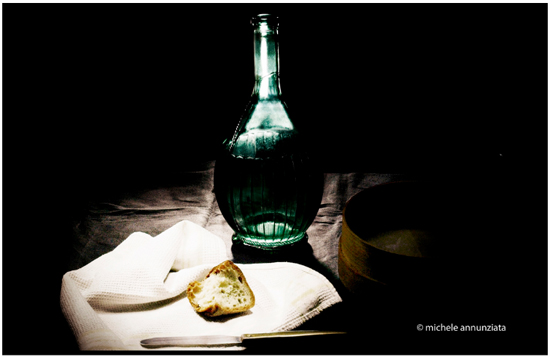
Still food in breve


Infatti ridotto all’essenziale il set. Una bottiglia che ricorda i vecchi fiaschi impagliati di una volta, una stozz’ (raffermo) di pane coltello di tutti i giorni (usato a tavola) un cernecch’ (setaccio per farina) e null’altro tranne il tovagliolo bianco. Tavolo d’ordinanza della mia sala da pranzo.
Luci: una sola e Led. L’immagine è assemblaggio di più scatti, non altrimenti. L’ambientazione è una “prova d’orchestra” su Olympus Point&Shoot di quello che al corrente è il “dark food”. E più in generale la richiamata orchestrazione ci conforta per altre immagini in itinere: work in progress

Man
search
ITA - Informativa sui cookies • Questo sito internet utilizza la tecnologia dei cookies. Cliccando su 'Personalizza/Customize' accedi alla personalizzazione e alla informativa completa sul nostro utilizzo dei cookies. Cliccando su 'Rifiuta/Reject' acconsenti al solo utilizzo dei cookies tecnici. Cliccando su 'Accetta/Accept' acconsenti all'utilizzo dei cookies sia tecnici che di profilazione (se presenti).

ENG - Cookies policy • This website uses cookies technology. By clicking on 'Personalizza/Customize' you access the personalization and complete information on our use of cookies. By clicking on 'Rifiuta/Reject' you only consent to the use of technical cookies. By clicking on 'Accetta/Accept' you consent to the use of both technical cookies and profiling (if any).

Accetta
Accept
Rifiuta
Reject
Personalizza
Customize
Link
https://www.manunzio.it/diary-d

Share on
/

Chiudi
Close
loading