manunzio.it logo


I don't...boh! Sony, excuse, What exactly do you want from me?


Out at sea, there’s a golden rule as old as wooden hulls: changing a boat’s name brings bad luck, but renaming one after a vessel that just sank—or was deliberately sent to the scrap yard—is basically a formal invitation for Neptune to drag you under. Evidently, in Tokyo, maritime superstitions don't carry as much weight as profit charts, so they just keep recycling the same acronym as long as there’s a single drop of juice left to squeeze from the brand. continue...
Then comes the "magic pill" chapter, which in our world translates to the absolute delusion of a featherweight file that somehow needs to be printable as a giant billboard. It’s the usual modern entitlement: the binge-eating without the calories, the 1 MB RAW file that is supposed to hold the dynamic range of a large-format sensor and enough detail for a six-by-three-meter print. They hunt for the magic algorithm because they simply lack the willingness to face the hard physics of light and silicon.

And that’s where the trap springs, leading right to the core of the matter: the Panasonic FZ300.

Now that is a machine built to work without throwing tantrums, a true workhorse. It costs a mere fraction of those boutique Sonys and, when paired with software that actually knows how to read a RAW file properly without turning detail into mush, it works miracles. We know the recipe:

A Leica lens that, despite the small sensor, stays at a constant f/2.8 throughout the entire zoom range (and excuse me if that’s not enough).

A file run through a proper RAW developer to extract every single pixel of clean information.

With a workflow like that, pulling off a clean 70x100 cm print—produced by a local service shop that still knows how to handle ink properly, even if their backroom sits right between the baker and the butcher—is no pipe dream. It’s craft. It’s knowing how to exploit the gear for what it’s actually worth, instead of letting yourself get skinned alive for the latest "miraculous" sensor packed into a body that costs as much as a medium-format kit from twenty years ago.

Let them rebadge and rebrand all they want. Those who actually know where to put their hands look at the final printed file, not the shiny golden badge on the strap.

Give it some thought, people. Allah Akbar....

(Copy & Past and...pay attention to alert of YouTube, eh)
https://www.youtube-nocookie.com/embed/lPyu5ki-jAw

Ps. A little Bible of cameras Panasonic, no way Sony...
https://grahamhoughton.jimdoweb.com/

Black is Black? No Black is Nothing

This stubborn, leaden sky forces this vertical biped—the tout court human—to go about, of all things, dressed (!?) in a single, definitive shade: Black. Capitalized, for reasons as heavy as this asphalt we walk on. It’s less a 'color' and more a naked exposure of these flat, pedestrian city thoughts; maybe 'cadaverous' is a better word. Dead thoughts walking.
If my historical memory serves, this wasn't the last time this kind of soot-black uniform was considered 'fashionable' around these specific Italian latitudes: Fascism. Sure, elsewhere (Europe in primis) there was a similar film of dust,, but the air felt different. It was quieter. Diminished, perhaps, but at least not this loud, look-at-me display that pretends not to look. For those who catch my meaning.
It's a fact: back then, everything was reduced to two tones—like this photograph, like the papers, the newsreels flickering in smoke-choked cinema halls. But. And this 'but' is for the Boot (geographic shape) itself or named 'Belpaese' (not let's not confuse that phrase with the soft cheese—that black wasn't a choice but was de facto uniformity again The Fascismo. The history books tell us exactly how that performance ended. But. Morto un Papa se ne fa un altro, as they say, or... maybe they just don't? 'Ni'—yes and no.
So, setting the metaphor aside (though I’m not sure how much I’ve set it aside), look at this scene. This current, lazy black of the jackets, the shoes, the everything. It's not depth. It's a dip into the same sticky, black pitch that, when you look closely, is just the Blackness of Death, settling in wherever the eye lands.
Sic transit gloria mundi! And this traffic we are creating is just the slowest, grimmest parade.


© archive manunzio

Intelligenti pauca verba
A constructed imagery (because I'm a artist-photographer tout court), certainly—an artifice where the etiology of Evil is well-known, yet that is not the point. This is not about the "history" that winners (!?) stitch together to wear as a shroud of certainty. It is about that moment when like a "child" discovers the ancient trick and cries out: "The King is naked."
Let us come to the present, to what this truly is. A gloomy morning under my own house—literally, a place no more than a hundred yards away as the crow flies. Tracks. An overcast sky. The shot you see here.
Even Auschwitz is not this "true." In fact, this is truer than the truth itself, reaching into that essence of eye-mind-heart where geography ceases to matter. Forget H. Cartier-Bresson; this is a different beast entirely. If you take this reconstructed image around, even without that infamous Arbeit... here in the West, they know. They recognize the "tip" and the built ideology, yet it is an ideology constructed upon the blood of others.
I am not in Poland. I am standing in the mundane perimeter of my own daily life, yet the geometry of the gate and the cold perspective of the rails tell the same story of oppression. By stripping the event of its historical museum-status and transplanting it into the gray silence of my neighborhood, the "truth" of the soul overrides the truth of the map. It forces the viewer to confront the fact that the architecture of the unthinkable is not a distant ghost, but a structural possibility hidden in the very tracks we walk past every morning.


© archive manunzio


This isn't just a corner; it's a puncture in the timeline. That sliver of white isn't an opening, it’s a glitch in the render of a youth that’s already elsewhere.

This is the silence of a square by De Chirico, but without the statues, just the raw geometry of a deadline. Look at that shadow: it’s vertical, heavy, and it doesn't just fall—it executes. It cuts the orange monolith in two, separating what was from what is, with the precision of a guillotine.

Everything is sharp, clean, and completely suffocating because it’s finished. You’re facing a rectangular nothingness that offers no exit, only the reflection of a moment that’s already slipping away.

It's a visual record of a fracture. The angle is a threat, the pipe is a boundary, and the window is a dead end. No more words needed. Tempus fugit, and the wall is the only thing staying still.


© archive manunzio


Screen play
Scene: The descent

(Character: Minosse (The Judge) Equipment: Olympus Point&Shoot, Monopod, ND Filter Atmosphere: High Key White / Haas Motion / The Weight of Remorse)


The road is a flat strip of asphalt that stays level for a hundred meters before the descent The Monumental Cemetery, who hosts the remains in the bare earth.
You are there with a point&shoot olympus and a monopod, capturing the physics of the end.

Look at the frames: on the right, the figures are already vanishing into the white, mere ghosts losing their grip on the world.
But behind them, in the center, stays minosse. He is the black mass, the weight of reality, the one who judges the walk.

He doesn't dissolve because he is the chronicle of what remains.
Using an ND (Neutral Density) filter and Ernst Haas-style motion with a simple point&shoot isn't about technical perfection or counting pixels—it's the raw evidence of the body surrendering to the blur.

What you did on this side of the line, before the slope, is your business.
As Pino Daniele italian singer said, if you don't get it now, you'll learn it at your own expense in hell—where nothing burns but the torment of what was left undone: the remorse.


First — literary reading

It’s a place that offers no resistance: the landscape doesn’t say no, it simply stops responding.
Snow flattens everything, fog erases distance, the horizon withdraws like a sentence left unfinished. There is no drama, no gesture — only suspension.

Within this near-total quiet appears an alien sign, rigid and vertical.
The pole is thin, the sign is small, yet it holds the only remaining word. It doesn’t point, it doesn’t warn: it records an absence.

The land seems to have lost its memory of itself.
It isn’t desolate — it’s inaccessible. Like a page that still exists but no longer returns its text.

Second — metaphor

It works because a digital code is transplanted into the physical world without translation.
“404” isn’t explained, isn’t softened: it remains a cold, bureaucratic marker — and that is precisely its strength.

The metaphor isn’t technological.
It’s existential.

Searching and not finding

Moving forward and receiving no reply

Being in the right place, but at the wrong moment for meaning

The landscape isn’t broken; it’s out of service.
And the sign doesn’t announce a failure of the world, but a failure of our expectation — the belief that something must answer us.

If it resonates, it’s because it doesn’t explain.
It simply states.


Ps. Ipse dixit (said...from ChatGPT)


© Copyright archive manunzio


'nderr' 'nderr' bankanderr'
Less is more, no? I don't no...Image orchestration in Pshop: frame. Inside the windows (specular) the couds seems a little lightning.
Below windows a tiny advise: Proprietà Privata Divieto. Private Property not consentite (any thigs).
Like an espresso the image, a street photo shoot rear any Bank of any Bankister, symbolize the life from Babylon-Babel Tower (bedlam, chaos, confusion) a this day, financialization also a "breath of fresh air". Chapeau.

Ps. Images from Olympus Wz 5060 a simply Point&Shoot, but a great eye of photographer that make it


Upgrade

Un blog di “compatte” che seguivo tempo fa e anche adesso si può gustare come un buon bicchiere di vino spagnolo. Si perché l’autore è iberico e decisamente fuori squadra e pure compasso, va mo’ tu a sapé. Chiariamo per i perfidi CaNikonisti, qui non trovate vagonate di minchiapixel (vocabolo coniato tempo addietro mettendoci a prestito un siculo “attributo” con Pi X El che pronunciamo erroneamente pixel ma non così, poiché molto più esoterico) ma immagini altamente creative con una manciata di bit quanto basta. Evidente che per i laudatores “duopolio” non significa molto però se uno fa la conta del “pixel”, come dire: de gustibus. E questo al più sono operazioni commerciali da famigerato Store via Internet, che usiamo pure noi cum grano salis.
E il blog offre il destro, ma pure mancina, a chi scrive che nel corso di un “ventennio (pare che nel Belpaese sia l’unità di misura della linea temporale eventi) ha storato su hard-disk (bello è grammaticalmente esatto il francese disc-dure che così sarebbe anche in italiano, ma esterofili a telecomando…) centinaia e centinaia di GB, ripresi con “macchinette” Point&Shoot, si, ma della gloriosa stirpe Olympus: fotocamere per buongustai

Buscado la magia de la luz
Juan Carlos Martin Flicker gallery


Olympus C- 5050
Una Leica…a mandorla
Aqua de Marco


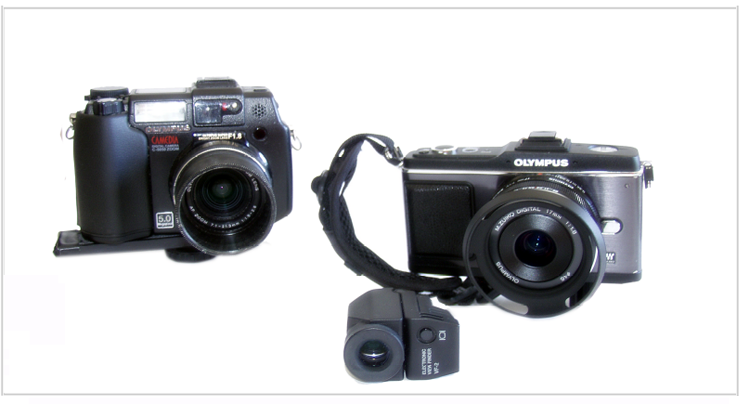
Ps. L’immagine del post è una foto di “famiglia” con vetusta e pur sempre tosta C- 5050 in perfetto esercizio, affiancata da una Ep-2 (trovata in buono stato e manciata di Euro) su formato M 4/3 e dotato di un bestiale 35 millimetri, su passo Leica, f 1.8. Un upgrade notevole, oltre l’antitremolio a bordo Ep-2 che evita, nei limiti del possibile, il ricorso ad alti Iso a tutto vantaggio della levigatezza, ecco, dell’immagine finale, comunque sempre usabile grazie a miracoli di Olympus. Aggiornamento Ep-2, quindi, di un già sperimentato 1.8 su la C-5050 dei miracoli. E per altrettanta manciata di Euro, il pentaprisma da innestare ‘ncoppa o contatto caldo (hot shoe per gli esterofili incalliti). L’inquadratura è della sempre verde E-20 e suo 2/3 di CCD altrettanto portentoso by Kodak. Quadro di famiglia, si è detto, e ripetiamo per buongustai fotografi


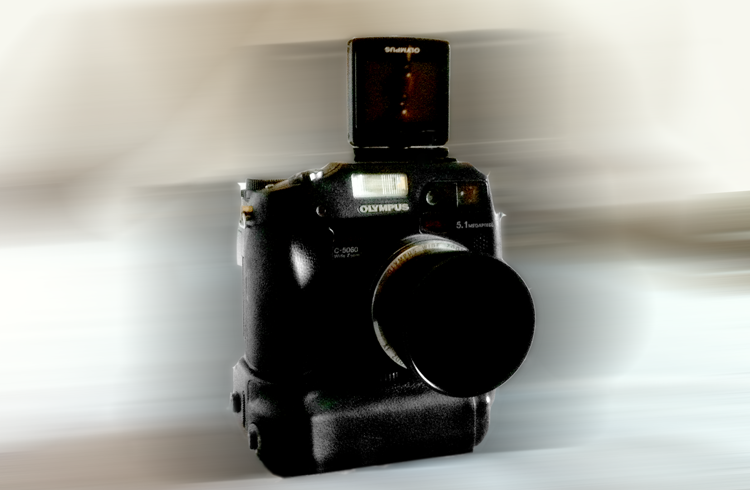
5060 (post obsolescenza programmata)

A non farci caso tant'è l'abitudine, male. Anzi come una bolla che viene dagli abissi si presenta, e chiede conto. E allora non si può far finta di niente, e d'altronde sta scritto: “Date a Cesare...” E sia. Anzitutto i numeri non sono segni grafici, casomai per Excell dei ragionieri di Casoria, quanto e forse presagi. Tant'è vero che se fate così: 5 + 6 escludendo nel caso gli inutili zero, il totale è un bell'Undici: Giustizia numerologica? Può anche darsi e mai dire mai. Siché tolto il riferimento kabalistico, resta la sostanza di una camera fotografica targata Olympus seguente i precedenti, tutti ben risusciti. Vero è che tra gli eterodiretti prezzolati (con famiglia) tra le point & shoot, che qui si narra, è conosciuta più la saga Nikon Coolpix (sebbene antecedente ad esse una Fujifilm veniva proposta per “reportage” e spiace non trovare il numero di Progresso Fotografico che ne trattò).
Sia come sia il ramo cadetto delle “punta & scatta” è stata la palestra tecnologica per le linee professionali: laboratorio se vogliamo. E questo vale anche seppure in maniera limitata in Era analogica quando certe feature comparvero prima in serie “cadetta”.
5060, dunque, e precedente modello 5050 di Casa Olympus, ma che sarebbe fuorviante metterla così, poiché due linee diverse e tutt'altro che antagoniste. La prima con una “dolcezza” per farci di tutto e di più, la seconda con un taglio, senza virgolette, pure escludendo del tutto il settaggio di default, è ineguagliato e con la strepitosa apertura f 1.8 su lillipuziano sensore. E non di meno assimilabile (nientemeno) che a Leica per prova ben più che provata verificata e stampata e poi Majoli docet.
E di nuovo 5060 che l'archivio digitale venutasi a strutturare negli anni (gerarchizzato da vetusto Lightroom v. 5.5) è per buon novanta percento Opera, maiuscola per chi intende, di questa incredibile fotocamera digitale. E del suo booster per due pile inside a creare un attrezzo magnificamente brandeggiabile, di una autonomia spaventevole: giornate intere con il monitor aperto (sebbene la camera ha un tunnel passato per mirino ottico e scarsamente praticato).
Insomma una 5060 conosciuta sin nelle remote pieghe, fatto che ha consentito a Manunzio di essere ciò che vedete, in caso di specie nel Portfolio per esempio.
E per gli schiumanti e biechi prezzolati la pagina della Getty Images è quanto di più eloquente al riguardo: senza se e senza ma. Infine parafrasando l'anglo-napoletano (magistrato) Henry John Woodcock...e fotograf' parlan' co' è fotogramm' oj né!


Ps1 Tranne l'immagine, sul sito Getty richiamato, delle finestre su Epson 850 Z quelle di food bianconero riprese su stellare nitidezza di C-8080 sempre di Casa Olympus, il resto è della “morbidezza” C-5060 Wz

Ps2 Siamo per i confronti arditi, apparente, secondo i codici codificati e prezzolati di Stampa&Regime (con famiglia) del settore. Insomma poco incline a baciapile e iscrizione a Logge cui deriva lo status e lauto conto bancario di fotografo di Regime tout court. Così come in Era analogica non c'è stato sistema (brand) provato e soluzioni in camera oscura (bianconero colore e sviluppo invertibile) provate e sperimentate “controcorrente” per poter poi fotografare con scienza e soprattutto fantasia, parimenti in Epoca digitale cominciata su computer Amiga che la solerte eterodiretta “stampa” misconosce preferendovi una “mela” morsicata cui pure si sta digitando. Siché alla 5060 il passo più che breve in considerazione che la si è usata per la cerimonia di nozze del fratello in tandem con una Epson 850 Z e nel Diary se ne parlato. Insomma più che confronti aridi, fine a se stesso, cognizione di causa come al solito

Ps3 L'immagine a corredo è di un “misero” iPhone 4 con post-produzione in PS Elements quando si è creativi, viceversa Lightroom per fare i “fotografi” di grido

search
i
ITA - Informativa sui cookies • Questo sito internet utilizza la tecnologia dei cookies. Cliccando su 'Personalizza/Customize' accedi alla personalizzazione e alla informativa completa sul nostro utilizzo dei cookies. Cliccando su 'Rifiuta/Reject' acconsenti al solo utilizzo dei cookies tecnici. Cliccando su 'Accetta/Accept' acconsenti all'utilizzo dei cookies sia tecnici che di profilazione (se presenti).

ENG - Cookies policy • This website uses cookies technology. By clicking on 'Personalizza/Customize' you access the personalization and complete information on our use of cookies. By clicking on 'Rifiuta/Reject' you only consent to the use of technical cookies. By clicking on 'Accetta/Accept' you consent to the use of both technical cookies and profiling (if any).

Accetta
Accept
Rifiuta
Reject
Personalizza
Customize
Link
https://www.manunzio.it/diary-d
copy copied!

Share
/ / email


Counter
520.750

Terms
cookie, privacy and copyright

Powered
myphotoportal.com

Chiudi
Close
loading