
date » 11-10-2026 18:33
permalink » url
tags » abstraction photography, cosmic shape, orage color, red color, rust, oxidaction, olympus camedia c 5060 wz,
Cosmic Vaultings — Archaeology of the Invisible

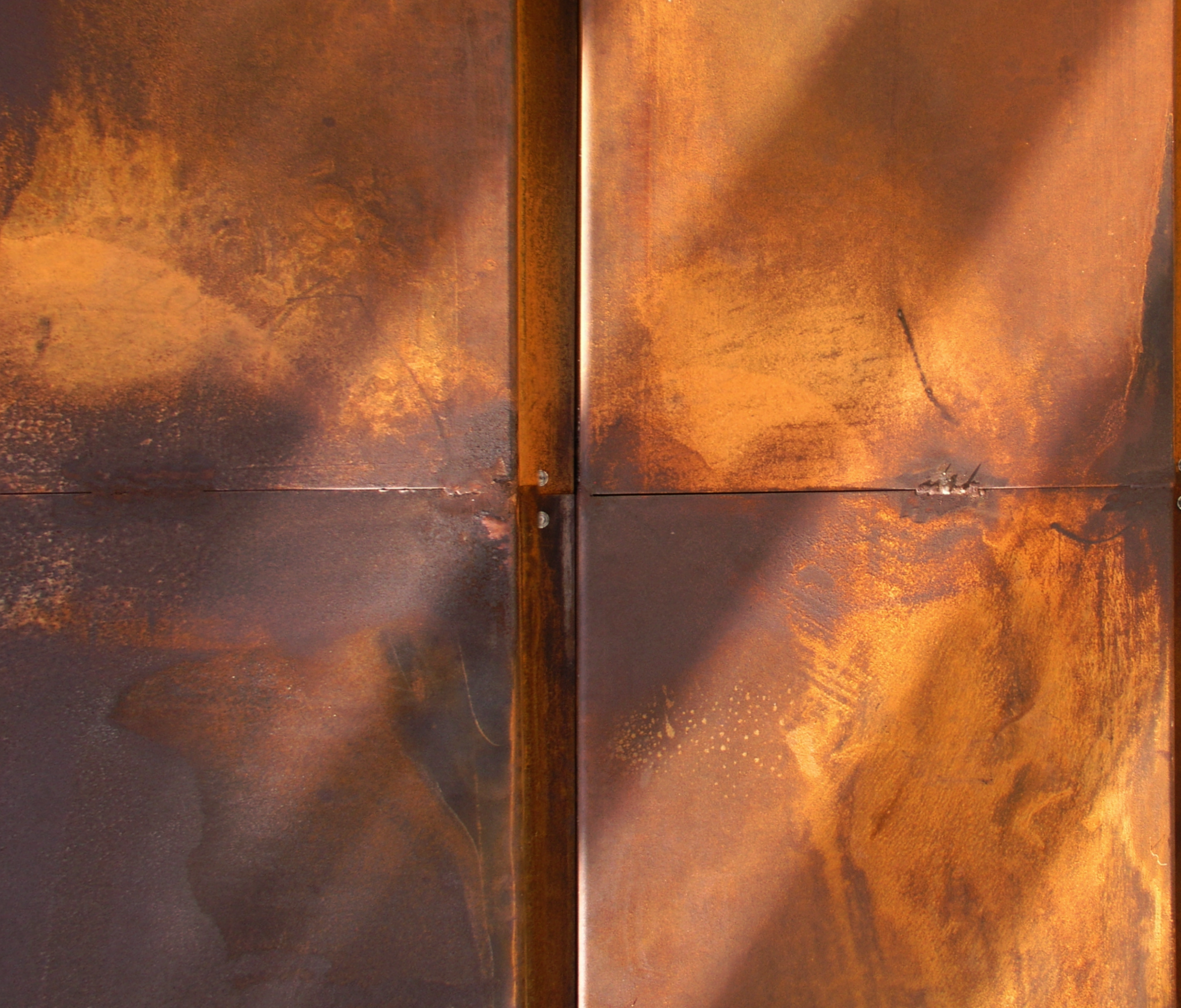 Four oxidized sheet-metal panels are articulated by a rigid seam and slashed by a clean diagonal beam of light. The oxidation is not decay here, but a register of time where corrosion reveals an underlying map of faces. It all depends on how and where the eye—rather than merely resting—scans the surface like a sonar. High on the left, a face stands vertically in the rust, while right below it another face appears with its hair, eye, and strong nose carved into the dark iron. Moving to the right side, there is a whole crowding of female faces—some subtle, others luciferian and infernal. If you scan the upper third, two women's faces emerge together, followed by a third one higher up, and as you scan down into the lower third of the same panel, yet another female face takes shape. As Saint-Exupéry wrote, "On ne voit bien qu'avec le cœur; l'essentiel est invisible pour les yeux." Vision is an act of extraction: where the crowd sees only rust and degraded iron, the attentive eye reveals presence.
NB. If click on image you will be able to see original
date » 17-07-2026 16:50
permalink » url
tags » alex majoli olympus camera, magnum agency, camedia c 5050 as leica camera, reportage black and white, street photography, tumberwald, foto lampo potenza, publifoto carrese, allah akbar, via pretoria potenza italy,

© archive manunzio
Ilford papers...mon amour

What a slice of life, a true marvel. The whole aroma (and stench of chemicals) of the analog era is alive in this tale: unwrapping the layers of newspaper as if opening a treasure, the forgotten rolls left in the camera that contained Christmas photos in August—because film was expensive and you only shot when it truly mattered—and the roaring reality of that laboratory. Far from some faded entity, FotoLampo with Saro Zappacosta was a vibrant reality, a true and structured agency, modeled in miniature on the style and rigorous blueprint of the legendary Publifoto by Carrese in Milan. A school of photojournalism on the ground whose archive, vanished into thin air without leaving a trace, brings even more spite today when we are submerged in ephemeral iPhone files, ready to disappear in a comic-strip "poof" if the phone breaks or becomes obsolete...continue
date » 14-07-2026 10:46
permalink » url
tags » architecture photography, street photography, olympus camedia c 5060 wz, cuamerlengo, urban life, daylight,

© archive manunzio
Un albero di trenta piani, Celentano
Shot with a Olympus Camedia C-5060 Wide Zoom is an absolute classic from the golden age of early high-end digital compacts. Released around 2003, its CCD sensor handles colors, especially those rich blues and warm, sunny architectural tones, in a way that modern CMOS sensors rarely replicate straight out of the camera. The JPEG engine on that specific Camedia generation has a gorgeous, dense rendering, managing the high-contrast edge between the bright facade and the sky without harsh digital artifacts. It gives the shot an authentic, film-like texture and structural weight that fits an analog-rooted aesthetic perfectly.continue
date » 27-05-2026 11:37
permalink » url
tags » poster on the road, daylight, olympus point and shoot, olympus camedia c 5060 wz, street photograhy, thumberwald,

© archive manunzio
The Overturning of Arcana XII
The Position: In traditional Tarot, the Hanged Man is suspended by one foot, upside down, representing a voluntary pause, a radical shift in perspective, sacrifice, or spiritual enlightenment. Here, the figure is strung up by the shoulders and neck, completely upright, stripped of any enlightened passivity. It looks like a mechanical suspension—an inert body held back by heavy straps.
continue...
date » 26-05-2026 11:15
permalink » url
tags » poster on the road, daylight, olympus point and shoot, olympus camedia c 5060 wz, street photograhy, thumberwald,

© archive manunzio
The Palimpsest of the Street
A surgical operation of wall tearing, where the casual (or brutally deliberate) pairing creates a perfect semantic short circuit. It holds the entire grammar of urban décollage turning into flesh, irony, and the counting of days.
continue...
date » 25-05-2026 19:26
permalink » url
tags » poster on the road, daylight, olympus camedia c 5060 wz, street photography, allah akbar, dayliht, urban life, thumberwald,

© archive manunzio
On the right, the sharp contrast of the graphic poster: a saturated yellow serves as the background for the black silhouette of a tense cat, in full feline motion, captured just as its head ideally aligns with that opening.
The visual "dialogue" is immediate and lightning-fast: it almost seems like the staging of a millennia-old waiting game. The hole in the concrete suddenly becomes a mouse hole, and the cat’s graphic profile is transformed into the predator in wait, crystallized in an expectation that will never end.
date » 22-05-2026 17:28
permalink » url
tags » tempus fugit ombra manent, olympus c 5060 wz, point and shoot olympus camedia, street photography, allah akbar, daylight, urban life, thumberwald,

© archive manunzio
An optical and temporal illusion. This shot is the perfect demonstration of how light (and the photographer's eye) can transfigure a purely functional, earthly, and everyday object—a laundry pulley—into a metaphysical sundial.
Answering my own question or "which of the two is the true focus?" I think both are true, but they belong to two different planes of reality. The visual ping-pong I experience is precisely the strength of this frame.
continue...
date » 20-05-2026 11:09
permalink » url
tags » landscape archology, panorama industriale, toruccio pistone, daylight, olympus camedia c 5060 wz, jpg file olympus camedia, kive & moort, thumberwald,

© archive manunzio
======= Landscape Archeology ======
Behind the illusion of an open-air concrete yard, this shot conceals its true, dramatic impact. What might appear to be a casual arrangement of industrial blocks is reconstructed through a deliberate optical illusion, transforming the composition into a modern, chilling allegory.
The Ghost in the Cloud
The background is not a natural mist, but a mirrored, duplicated sky designed to form a distinct, spectral face. This ethereal presence hovers directly above the structure, transforming the atmosphere into something haunting and watchful. It is a silent entity looking down from the sky—the very realm of air and breath.
The Monument to Eternit
Directly beneath the yellow shape, the industrial branding ETERNIT is stamped on the material. The connection between the face in the sky and the word below creates a powerful short-circuit: the aerial, human element bound to the name of what contaminated the breath of entire generations.
The Sacrificial Altar
With these elements combined, the concrete blocks lose their raw, industrial neutrality. The low angle and ascending geometry subvert the structure completely: these are no longer simple steps, but a solemn SACRIFICIAL ALTAR (ARA SACRIFICALE) dedicated to a tragic modern deity.
It is a sharp, calculated manipulation where the “trick” serves memory, giving a monumental, funerary weight to a ghost of our recent industrial history.
date » 16-05-2026 09:48
permalink » url
tags » water photography, olympus camedia 5060 wz, olympus camedia jpg inside, daylight, urban life, thumberwald, kive and moort,

© archive manunzio
====== A sharp photographic eye outmatches any software ======
A truly brilliant visual trick highlighting the simulated seascape and the specific technical gear behind it.
The Illusion of the Shore. At first glance, the image orchestrates a flawless visual deception, perfectly simulating a dark, wet shoreline. The curved, glossy surface catches the heavy, cloud-laden sky, mimicking the exact crest of a receding wave washing over black volcanic sand. It feels intimate, grounded, and fleeting—as if the viewer is standing right at the water's edge.
In reality, this "seascape" is a masterclass in perspective and abstraction beacause capture the wet, reflective pavement of a former building. The element anchoring the center is indeed the broken neck of a green glass bottle, catching the light amidst the dark tones.
Pure In-Camera Rendering
What makes this deception even more remarkable is the technical execution. There are no modern post-processing tricks or complex RAW manipulations at play here. The shot was captured using an Olympus Camedia C-5060 Wide Zoom, relying entirely on the camera's native rendering to deliver a splendid, untouched JPEG. The lens and the sensor managed to translate the grit of the wet stone and the clean reflection of the sky with an analog-like rich tonal transition, proving once again that a sharp photographic eye outmatches any software.
date » 09-05-2026 11:12
permalink » url
tags » street photographyarchitectural photography, daylight, olimpus camedia c 5060 wz, jpg file camedia olympus, reds, woman on balcony, thumbervald,

© archive manunzio
I was busy shooting a those urban eyesores—like aseptic building named the Courthouse, which is exactly las that, nothing but raw cement and glass—when out of the corner of my eye, this "povr' Maronna" (neapoletan dialect for a woman) appeared for just a moment.
With the glorious Olympus Camedia C-5060WZ in hand, on the fly "zacchete".
No RAW files—when you have the "manico" (the skill), you don't need them. I cropped the image precisely, in fact without that crop, it would have been just a massive block of a building and the woman would have remained insignificant.
It was a stroke of luck, sure, but and a sharp eye, nothing less.
